Is There a Difference Between Squash and Racquetball?
If you are asking “is there a difference between squash and racquetball?”, the short answer is yes. Both are four-wall racket sports, but they use different court dimensions, wall markings, balls, rackets, and rule systems. A standard squash court is shorter and wider than the standard American racquetball reference, while a racquetball court is taller and designed around a playable ceiling. Those differences change how players move, how shots are selected, and how a facility should be specified.
For operators, the distinction prevents a familiar-looking room from being described as the wrong sport. A facility brief should identify the sport, format, governing rules, court envelope, and intended use before dimensions or equipment are finalized.
Are Squash and Racquetball the Same Sport?
No. Squash and American racquetball share the idea of keeping a ball in play within a bounded court, but they are separate sports with separate specifications and governing rules.
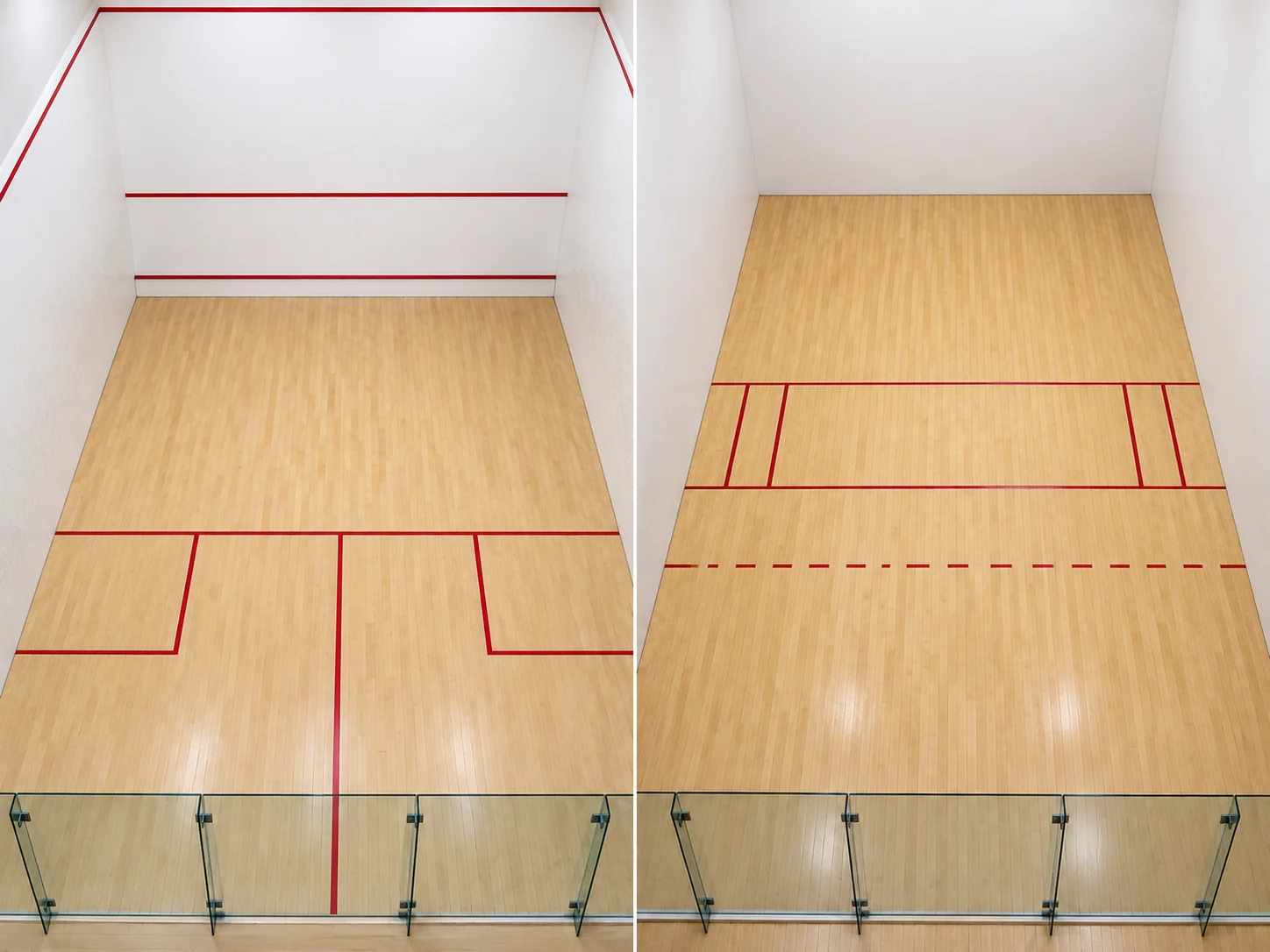
Squash is played on a court with a front wall, two side walls, and a back wall. The front wall includes a lower limit called the tin and an upper out line. Shots that land outside the permitted area are out. American racquetball also uses four walls, but the standard court is enclosed by a playable ceiling and does not use the squash tin-and-out-line layout.
UK racketball, also known as Squash 57, is not another name for American racquetball. It is a separate game played on a squash court, so identify the exact sport and rule set first.
Squash vs Racquetball at a Glance
The table uses cited standard references; confirm current governing rules for a specific event or facility.
| Feature | Squash | American racquetball |
|---|---|---|
| Standard court reference | Approximately 9,750 mm long × 6,400 mm wide (about 32.0 ft × 21.0 ft) for a singles court | 40 ft long × 20 ft wide × 20 ft high (about 12,192 mm × 6,096 mm × 6,096 mm) four-wall court reference |
| Vertical space | A minimum clear-height reference is published for squash courts | The ceiling is part of the playable court envelope |
| Front-wall layout | Tin below the lower playing limit; out line above the playing area | Different wall markings and no squash-style tin layout |
| Ball | Smaller, lower-bounce ball in the usual comparison | Larger, livelier ball in the usual comparison |
| Racket | Shorter racket format with a smaller head profile in common equipment comparisons | Longer racket format with a larger head profile in common equipment comparisons |
| Scoring | Point-a-rally scoring in the cited squash format | Side-out scoring in the cited traditional format; formats can vary |
The practical answer is not just “one court is bigger.” Geometry, ball response, racket reach, and scoring work together.
How the Courts Differ: Size, Walls, Ceiling, and Lines
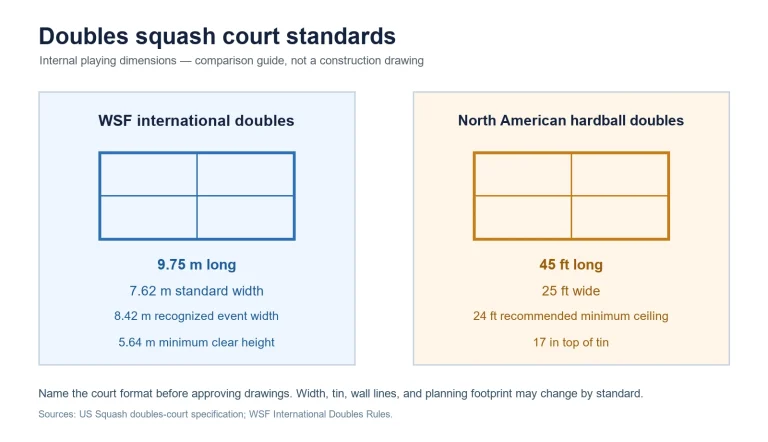
The most important difference in a squash court vs racquetball court comparison is the playing envelope. The cited squash singles reference is approximately 9,750 mm long × 6,400 mm wide (about 32.0 ft × 21.0 ft). The cited American racquetball reference is 40 ft long × 20 ft wide × 20 ft high (about 12,192 mm × 6,096 mm × 6,096 mm). In simple terms, a racquetball court is longer and taller, while the squash reference is wider relative to its length.
That does not mean a room with similar dimensions can automatically serve both sports. The front wall, side walls, back wall, ceiling, floor, door position, markings, and clearances all affect play. A squash court needs its characteristic front-wall lines and tin. A racquetball court needs a configuration in which the ceiling and all four walls are part of the defined playing space.
For a venue brief, document internal playing dimensions separately from the wider building envelope. Also record circulation, access, lighting, ventilation, and maintenance clearances. Before dimensions are fixed, LDK’s Court Systems page helps frame the comparison around practical venue decisions—indoor or outdoor setting, freestanding or integrated structure, protection from weather and the experience expected by users. Final dimensions, finishes and project requirements still need site confirmation. Review LDK Court Systems
Balls and Rackets Create a Different Playing Response
The equipment is another reason that a squash vs racquetball comparison cannot be reduced to court length. A conventional squash ball is smaller and is commonly described as producing a lower-bounce response than a racquetball. A racquetball is larger and livelier, so it can travel differently through the larger court envelope.
The rackets also serve different playing patterns. Squash rackets are generally shorter and more compact. Racquetball rackets are generally longer, with a larger hitting area in common equipment descriptions. These are orientation points, not a universal ranking of difficulty; conditions and playing style also matter.
The safest purchasing rule is simple: use equipment intended for the sport and ruleset selected for the court. Do not assume that a racket or ball labelled for one sport will reproduce the same timing, reach, or bounce in the other.
Squash vs Racquetball Rules: Serving, Scoring, and What Counts as Out
The rules are different at several basic points. Under the cited squash format, every rally can produce a point. Under the cited traditional American racquetball format, the serving side scores, so a rally does not automatically award a point to the receiver. Racquetball competition formats can vary, so confirm the applicable rules before publishing a facility rule sheet.
Service mechanics also differ, so the two sports should not share a single simplified service diagram. Squash uses a service box and a defined front-wall target; racquetball uses a different serving area and return sequence.
“Out” is also sport-specific. In squash, the tin and front-wall out line are part of the court’s defining visual language. In racquetball, the full playing enclosure, including the ceiling, is central to the rally. For accurate squash vs racquetball rules content, name the governing body and format instead of presenting one set of rules as universal.
Can You Play Squash on a Racquetball Court?
You may be able to use a racquetball court for informal squash drills, but that is not the same as having a standard squash court. A formal conversion is a design and verification task involving geometry, wall features, line layout, floor conditions, ceiling clearance, door position, and the intended ruleset.
Use this diagnostic path before describing the space as a converted court:
| Symptom | Likely cause | Verify | Safe next action |
|---|---|---|---|
| The court feels too long for squash | The racquetball playing envelope is longer | Check internal length against the applicable squash reference | Limit use to drills or commission a conversion review |
| Shots use an unexpected wall or ceiling area | Wall, ceiling, or line rules differ | Identify the court type and inspect the markings, tin, and ceiling | Do not call it a standard squash match setup without the required features |
| Footing feels unfamiliar | The floor finish or maintenance approach differs | Check the floor specification, finish, and traction policy | Ask the venue operator before changing the surface |
| The project team cannot agree on the layout | The sport format and ruleset were not fixed | Record sport, singles or doubles, ruleset, and site constraints | Freeze the brief before drawings or quotation |
The community questions behind this topic often mix three different goals: a casual practice session, a temporary multi-sport use, and a formal conversion. Treat them as different decisions. For a possible conversion, LDK’s Find & Compare page is useful for organizing the first supplier conversation around venue type, site context and intended use. It is a starting point, not a substitute for checking the final court geometry, wall features, floor, access and governing rules for the project. Use LDK Find & Compare
Which Court Format Fits a Facility Brief?
Start with the intended use, not with a preferred product label. A useful facility brief should answer:
- Which sport will be played most often?
- Is the court for singles, doubles, coaching, recreation, or competition?
- Which governing rules and dimensions apply?
- Does the available envelope provide the required length, width, height, walls, ceiling, and access?
- How will the floor, lighting, ventilation, cleaning, and routine inspection be managed?
- Is future flexibility more important than a single-sport specification?
This process lets a project team compare both court formats on the same basis. It also makes supplier discussions more precise because the brief records the playing format, site constraints, and verification points before drawings or quotations are prepared. LDK’s planning guidance gives teams a way to frame that conversation around venue context and intended use before requesting project-specific confirmation.
Planning Support for Facility Teams
If you are comparing court formats for a new venue, conversion, or multi-sport project, share your site conditions, intended sport, playing format, and preliminary dimensions with LDK. That information gives the supplier conversation a clear starting point, while final specifications still require site and ruleset confirmation. Start an LDK project comparison.
FAQ: Common Squash and Racquetball Questions
Are squash and racquetball the same game?
No. They are separate wall-based racket sports. They share a four-wall concept, but their court dimensions, front-wall features, balls, rackets, and rules differ. This answer refers to American racquetball; UK racketball or Squash 57 is a different game played on a squash court.
Is a racquetball court bigger than a squash court?
It depends on the dimension. The cited squash singles reference is approximately 9,750 mm long × 6,400 mm wide (about 32.0 ft × 21.0 ft). The cited American racquetball reference is 40 ft long × 20 ft wide × 20 ft high (about 12,192 mm × 6,096 mm × 6,096 mm). A racquetball court therefore has a larger length and height reference, while the squash court is wider relative to its length.
Can you play squash on a racquetball court?
Casual drills may be possible, but a racquetball court should not automatically be called a standard squash court. Check the internal dimensions, front-wall markings, tin, ceiling, floor, door position, and applicable rules. If the use is intended to be formal or permanent, treat it as a conversion review rather than an informal equipment swap.
Are squash and racquetball rackets interchangeable?
They are not the same equipment specification. Common squash rackets are shorter and more compact, while racquetball rackets are generally longer with a larger hitting area. Use equipment intended for the selected sport. If a venue is designed for more than one activity, test the proposed equipment and ruleset against the final court layout.
Which ball bounces more?
Racquetball is generally described as the livelier-bouncing ball in the standard comparison, while a squash ball is smaller and typically produces a lower-bounce response. The exact playing feel can change with ball type, temperature, court conditions, and player technique, so bounce alone should not be used to rank difficulty.
Is UK racketball the same as American racquetball?
No. UK racketball, also called Squash 57, is a distinct game played on a squash court. American racquetball uses its own court reference, equipment, and rule system. Confirm the terminology with the governing body or event organiser before selecting dimensions, markings, or equipment.
Sources
Official rules and specifications
B2B PROJECT SUPPORT Share your floor plan, site dimensions and intended court configuration. LDK can help review the spatial brief and prepare the next specification step.Planning a new squash venue?